

You stand in front of a shelf full of detergents, and suddenly the choice no longer seems so simple. Powder, liquid detergent, or capsules? For whites or coloured laundry? Universal or designed for delicate fabrics? And then there is still the question of how much detergent to put in the washing machine>
Most often, we reach for a product we already know, one that is on sale, or simply one whose scent we like. However, choosing the right laundry detergent can affect washing results, help preserve colours and fibres, and determine whether detergent residue remains on clothes after washing.
There is no single detergent that is best for every situation. The right choice depends on the type of laundry, colour, material, level of soiling, washing programme, and water hardness. That is why we will start with the most common dilemma: powder, liquid detergent, or capsules?
Powder, Liquid Detergent, or Capsules – Which Should You Choose?
Laundry Powder
Powder detergent is one of the longest-used forms of laundry detergent and still offers several advantages.
Powders designed for white laundry often contain ingredients that help maintain whiteness, such as oxygen-based bleaching agents and optical brighteners. This can make them a good choice for white cotton bed linen, towels, T-shirts, and similar items.
Another advantage is the ability to easily adjust the amount of detergent. For larger or more heavily soiled loads, or in areas with harder water, the dose can be adjusted according to the manufacturer’s dosing instructions.
On the other hand, using too much powder or a wash programme that uses little water can result in poor dissolution and detergent residue on clothes. This problem is more likely to occur if the product is used contrary to the manufacturer’s instructions or if the washing machine is overloaded.
Laundry powder can be a good choice when:
- you frequently wash white cotton laundry
- you want to adjust the detergent dosage yourself
- you wash standard or heavily soiled loads
- the chosen product is suitable for the temperature and wash programme you use.
However, this does not mean that every powder detergent is automatically the best choice for white laundry. Always check what the specific product is designed for.
Liquid Detergent
Liquid detergents are convenient because they mix quickly with water and are easy to dose. They are often used for coloured and dark laundry, particularly formulas specifically designed to help preserve colours.
They can also be practical for shorter wash programmes and lower temperatures, although you should always check the recommendations provided on the product packaging.
Another advantage is the option of targeted pre-treatment of certain stains, provided that the manufacturer states that the product is suitable for this type of use.
The downside is precisely the ease of dosing: liquid detergent is easy to pour in “by eye”, which often results in using more than necessary.
Liquid detergent can be a practical choice for:
- coloured and dark laundry
- everyday lightly to moderately soiled laundry
- lower temperatures and shorter programmes, when the product is designed for them
- situations where you want to precisely adjust the amount of detergent.
Laundry Detergent Capsules
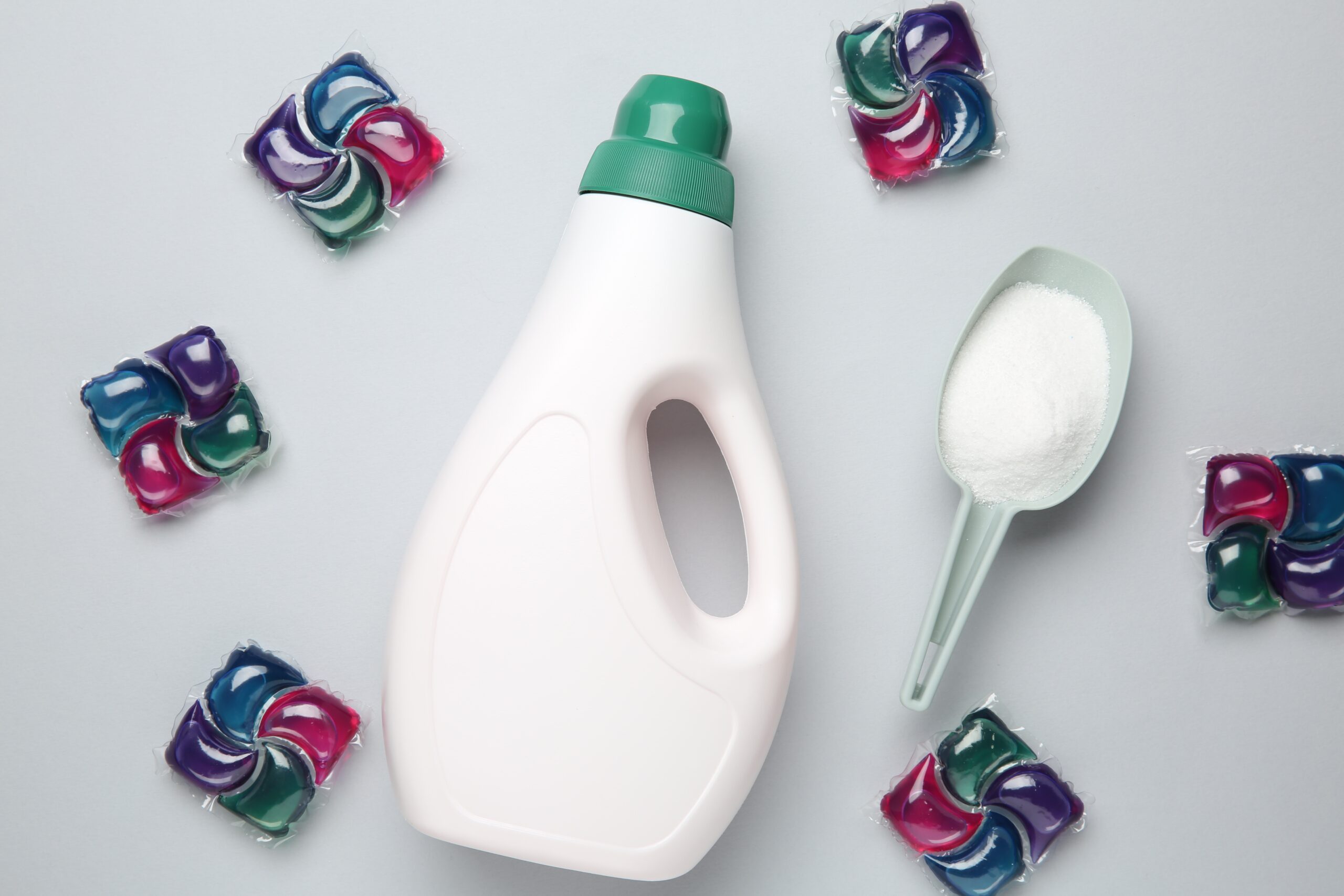
The main advantage of capsules is their ease of use. There is no measuring or spilling: simply use the appropriate number of capsules according to the manufacturer’s instructions and place them where indicated on the packaging, usually directly in the drum before adding the laundry.
Capsules contain a pre-measured dose of concentrated detergent, while some feature several separate chambers containing different components of the formula.
However, this convenience also has a downside. It is more difficult to fine-tune the dosage when washing a very small load or only a few lightly soiled items. With powder and liquid detergent, you can increase or reduce the amount more gradually.
It is also important not to automatically assume that one capsule is sufficient for every washing machine and every load. Washing machine capacity, load size, level of soiling, and recommended dosage vary from product to product.
If you use capsules, store them in a safe place and keep them out of reach of children.
It’s Not Just the Type of Detergent That Matters – What You’re Washing Matters Too
Detergent for White Laundry
Detergents designed for white laundry are formulated to help remove stains and maintain whiteness. Certain formulas may contain bleaching agents and optical brighteners.
That is why they should not automatically be used for coloured garments. Repeated washing with an unsuitable product can cause vibrant colours to gradually lose their intensity.
For white towels, bed sheets, cotton T-shirts, and similar items, choose a detergent that is clearly labelled as suitable for white laundry.
Detergent for Coloured and Dark Laundry
Detergents for coloured laundry are usually formulated with an emphasis on effective cleaning while helping preserve colours, without the same type of bleaching ingredients that may be found in products for white laundry.
This type of detergent is a good choice for most everyday coloured clothing.
However, it is still a good idea to be careful with new garments in intense colours. Follow the care label on the garment and, if necessary, wash it separately for the first few washes.
Detergent for Delicates, Wool, and Silk
Wool, silk, and other delicate fabrics require a different approach.
For these materials, it is better to use a detergent specifically designed for wool, silk, or delicate laundry, together with the appropriate washing machine programme.
Particular care should be taken with enzymes such as proteases. Their purpose is to break down protein-based stains, which also means they may not be suitable for certain fibres of protein origin. Rather than trying to determine suitability from the ingredient list alone, the safest option is to choose a product that the manufacturer specifically recommends for wool or silk.
For functional, sports, water-repellent, and other specialised clothing, you should also check the textile manufacturer’s care instructions first.

Surfactants – the Main Cleaning Agents
Surfactants, or surface-active agents, are among the key ingredients in laundry detergent.
Put simply, they help water come into better contact with the surface of textile fibres and help separate grease and dirt from the fabric so that they can be carried away with the water during rinsing.
Their molecules have one part that attracts water and another part that more readily binds to grease and dirt. This is precisely what allows detergent to do what water alone often cannot do effectively enough.
Enzymes in Laundry Detergent
Enzymes help break down certain types of stains into smaller components that are then easier to remove.
For example:
- proteases act on protein-based stains
- amylases help remove stains containing starch
- lipases help break down fats and grease.
This is one of the reasons why modern detergents can clean effectively even at lower temperatures.
Ingredients That Help with Hard Water
Water with a higher mineral content, particularly calcium and magnesium, can reduce the effectiveness of certain detergent ingredients.
For this reason, detergents may contain so-called builders or water-softening agents, whose role is to bind these minerals and allow surfactants to work more effectively.
Other Ingredients
Depending on the product and its intended use, the formula may also contain anti-redeposition agents, colour-protecting agents, optical brighteners, bleaching agents, foam regulators, fragrances, and other additives.
This is why two products that are both labelled simply as “laundry detergent” may not have the same intended use or deliver the same washing results.
How to Dose Laundry Detergent Correctly?
More detergent does not automatically mean cleaner laundry.
Using too much detergent can make it harder to rinse out, leave residue on fabrics, and contribute to build-up inside the washing machine. Using too little, on the other hand, may lead to poorer washing results, especially with heavily soiled laundry or hard water.
That is why there is no single universal amount that can be recommended for every wash.
When dosing detergent, consider three main factors:
1. Amount of Laundry
A larger load generally requires a different dose than just a few lightweight items. Do not look only at the washing machine’s maximum capacity – what matters is the amount of laundry you are actually washing.
2. Level of Soiling
T-shirts worn for a few hours and work clothes with visible stains do not require the same approach. The more heavily soiled the laundry is, the more important it is to follow the manufacturer’s recommendations for the appropriate dose.
3. Water Hardness
Hard water contains higher levels of calcium and magnesium, which can affect washing performance. For this reason, manufacturers often provide different dosing recommendations on the packaging for soft, medium-hard, and hard water.
The safest rule is therefore simple: follow the dosing table provided by the specific manufacturer and adjust the dose according to the amount of laundry, level of soiling, and water hardness.

Which Laundry Detergent Should You Choose and When?
| Situation | Recommended Choice | Why |
|---|---|---|
| White cotton bed linen and towels | Detergent designed for white laundry, often in powder form | These formulas often contain ingredients that help remove stains and maintain whiteness |
| Everyday coloured laundry | Liquid or another detergent labelled for coloured laundry | Formulated with an emphasis on effective cleaning while helping preserve colours |
| Dark clothing | Detergent for dark or coloured laundry | Reduces the need to use products containing ingredients intended for bleaching |
| Short wash programme or lower temperature | Liquid detergent if recommended by the manufacturer for that type of programme | Disperses quickly in water |
| You want the simplest possible dosing | Capsules | The dose is pre-measured, so there is no need for measuring |
| Very small or very large load | Powder or liquid detergent | The amount can be adjusted more precisely |
| Heavily soiled laundry | Suitable powder or liquid detergent with correct dosing and, if necessary, stain pre-treatment | Allows the dose to be adjusted and stains to be treated directly |
| Wool or silk | Special detergent for wool or silk | The formula is designed for delicate fibres |
| Sportswear or functional clothing | Detergent recommended for functional fabrics | Helps preserve the fabric’s special properties |
| Hard water | Detergent dosed according to recommendations for hard water | Higher mineral levels in the water can reduce washing effectiveness |
| Sensitive skin | A suitable product without unnecessary fragrances and additives, depending on individual sensitivity | The formulation and proper rinsing are more important than the detergent form itself |
What About Natural Detergents and Fabric Softener?
However, the label “natural” should not automatically be interpreted as a guarantee of better washing performance or suitability for every skin type and fabric. As with any other detergent, check the ingredients, intended use, dosing instructions, and product label.
You can read more about this topic in the iWash-uWash guide to natural laundry detergents.
Fabric softener is a separate product and is not necessary for every wash. Particular care should be taken with sportswear and functional clothing, water-repellent materials, and textiles where absorbency is important.
Read more in our guide When Should You NOT Use Fabric Softener?.
The Right Detergent Is the One That Suits the Specific Wash
When choosing a detergent, there is no need to look for a single winner among powder, liquid detergent, and capsules.
It is much more useful to consider what you are washing, how soiled the laundry is, which wash programme you are using, and how hard the water is.
For white bed linen, you may choose a powder detergent for whites; for dark T-shirts, a liquid detergent for colours; and for wool, a completely different product. Capsules can be the most convenient option when your wash loads are similar and you want to avoid measuring detergent.
The most important thing is to use a product that is suitable for the fabric and wash programme, dose it correctly, and follow both the garment care label and the detergent manufacturer’s instructions. This will help you achieve better washing results while also reducing unnecessary detergent use and strain on your washing machine.